PARALLELFIELD
| Site H Home P PRLFLD Science S Double slit E Entanglement C Schrodinger Geometry 5 Platonic solids M Mathematics 34 Durer square Art B Blake Al Alchemy Pr Print Quiz Q CultureCultura IQ IQ L LogicLogica Sp SpiritEspiritu Fe FeelingSentimiento Works * Emanations G Guestbook |
Hello worldOpen a note. The rail is the live slit. It does not hurry. Hello worldAbra una nota. El riel es la rendija en vivo. No se acelera. 
Double slitYoung 1803. Interference. Which-path kills the fringes. 
EntanglementEPR 1935. Bell 1964. Correlation, not a signal. 
Schrodinger1935 reductio. The cut is a model, not a photo. 
Platonic solidsFive regular bodies. Euclid XIII. Kepler nested them. 
MathematicsBits, phi, pinhole: x′ = f x / z. 
Durer squareMelencolia I, 1514. Every line sums to 34. 
BlakeAncient of Days, 1794. Compass as a cage. 
AlchemyFludd 1617. Correspondence, not a password. 
Goya 43: when reason sleeps, monsters breed. 
EmanationsWorks held in the container. RSS later. PRLFLDPRLFLD is a container, not a workshop. It does not make; it holds. Alpha and Omega are two readings of the same matrix, not two places. A reading is a cut through the field: which cells are marked, which stay blank. The same lattice can be read as a beginning (alpha) or as a remainder (omega). Neither reading deletes the other. The site that holds the notes is not the field. The field is the other page, the particle one. These notes only say what the objects are: the slit, the joint state, the five solids, the printed square, the plates. PRLFLDPRLFLD es un contenedor, no un taller. No hace; sostiene. Alfa y Omega son dos lecturas de la misma matriz, no dos lugares. ScienceThree notes: the double slit (Young, 1801), entanglement (EPR, 1935; Bell, 1964), and Schrodinger's 1935 thought experiment. Each article uses period images and explains the experiment, not a metaphor. Double slit interference, which-path, fringes Entanglement joint state, no signalling Schrodinger superposition and the cut CienciaTres notas: la rendija doble (Young, 1801), el entrelazamiento (EPR, 1935; Bell, 1964) y el gato de 1935. Cada articulo usa imagenes de epoca y explica el experimento. Rendija interferencia, camino, franjas Entrelazamiento estado conjunto, sin senal Schrodinger superposicion y el corte The double-slit experiment
Thomas Young (1773–1829). Wikimedia Commons. 
Electron build-up, Tonomura / Hitachi, 1989. Wikimedia Commons. Thomas Young presented the two-slit demonstration to the Royal Society in 1803 (work of 1801–1803). A single wavefront split by two close apertures produces bright and dark bands. Where crests meet crests, the screen is bright; where crest meets trough, it is dark. That is linear superposition of waves. The same geometry is used with electrons (Davisson–Germer 1927 as crystals; later single-electron build-up, e.g. Tonomura 1989). Atoms and large molecules also fringe. Intensity on the screen is not two lumps unless which-path information is recorded. If a detector distinguishes the slits, the bands vanish. “Observation” is a physical record that marks the path, not a glance. The rail SLIT EXPERIMENT uses the same particle field as the experiment site. It cannot be sped up. It keeps accumulating if you leave and return. Experimento de la rendija
Thomas Young (1773–1829). Wikimedia Commons.
Acumulacion de electrones, Tonomura / Hitachi, 1989. Wikimedia Commons. Young presento la demostracion de dos rendijas a la Royal Society en 1803 (trabajo 1801–1803). Un frente de onda partido por dos aberturas produce bandas. Cresta con cresta: claro. Cresta con valle: oscuro. Superposicion lineal de ondas. La misma geometria se usa con electrones (luego acumulacion de un electron, Tonomura 1989), atomos y moleculas grandes. Si un detector distingue las rendijas, las franjas desaparecen. Observar es un registro fisico, no una mirada. El riel SLIT EXPERIMENT usa el mismo campo. No se acelera. Sigue si te vas y vuelves. Quantum entanglement
Albert Einstein, 1921. Ferdinand Schmutzer. Wikimedia Commons. 
Niels Bohr. Wikimedia Commons. In 1935 Einstein, Podolsky and Rosen asked whether the quantum description of two distant particles was complete. A joint state can fail to factor into “state of A” times “state of B.” Measuring spin (or polarization) on A predicts the matching observable on B. No usable message is sent: you cannot choose an outcome on A to write a bit on B. The correlation lives in the joint description. Bell (1964) derived an inequality that local hidden-variable models must obey. Experiments (Aspect and later) violate it. Entanglement is correlation with a proof, not command at a distance. Bohr’s reply to EPR insisted that the experimental arrangement, not a hidden instruction list, defines the observables. Entrelazamiento cuantico
Albert Einstein, 1921. Wikimedia Commons.
Niels Bohr. Wikimedia Commons. En 1935 Einstein, Podolsky y Rosen preguntaron si la descripcion cuantica de dos particulas lejanas era completa. Un estado conjunto puede no factorizar. Medir en A predice el observable en B. No se envia un mensaje util. Bell (1964) y los experimentos posteriores violan las desigualdades locales. Es correlacion con prueba, no mando a distancia. Schrodinger's cat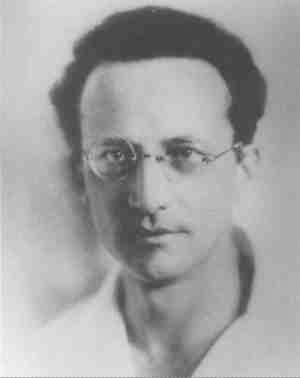
Erwin Schrodinger. Wikimedia Commons. In 1935 Schrodinger published a sealed-box story: a radioactive sample, a Geiger counter, a flask of poison, and a cat. If the decay is described by a superposition, the linear Schrödinger equation applied to the whole apparatus writes a superposition of “decayed / dead” and “not decayed / alive.” He offered it as a reductio ad absurdum against taking the wave function as a complete picture of everyday objects. Macroscopic superpositions decohere: the environment records which branch. The “cut” between quantum and classical is a modelling choice. It is not a photograph of a cat in two rooms. The live experiment on this site is the slit, not this story. Gato de Schrodinger
Erwin Schrodinger. Wikimedia Commons. En 1935 Schrodinger publico una caja: muestra radiactiva, Geiger, veneno y un gato. La ecuacion lineal escrita sobre el aparato entero da una superposicion “desintegro / muerto” y “no / vivo.” Lo ofrecio como reductio. Las superposiciones macroscopicas decoheren. El corte es modelo, no foto. El experimento vivo de este sitio es la rendija, no este cuento. GeometryRegular bodies, lattices, and a printed magic square. Kepler drew the five solids as nested cosmic cups. Durer engraved a 4×4 square that still adds to 34. Platonic solids five regular convex polyhedra Mathematics bit lattice, phi, pinhole Durer square Melencolia I, 1514 GeometriaCuerpos regulares, redes y un cuadrado magico impreso. Kepler dibujo los cinco solidos. Durero grabo un 4×4 que suma 34. Platonic solids
Johannes Kepler, 1610. Wikimedia Commons. There are exactly five regular convex polyhedra: tetrahedron (4 triangular faces), cube (6 squares), octahedron (8 triangles), dodecahedron (12 pentagons), icosahedron (20 triangles). Each face is the same regular polygon; the same number of faces meet at every vertex. Euclid proves the count in Book XIII of the Elements: a sixth regular solid cannot close in three dimensions. In the Timaeus, Plato assigns tetrahedron to fire, cube to earth, octahedron to air, icosahedron to water, dodecahedron to the cosmos. Kepler, in Mysterium Cosmographicum (1596), nested the five as cups between planetary spheres. That assignment is cosmology. The five-count is geometry and does not depend on planets. Solidos platonicos
Johannes Kepler, 1610. Wikimedia Commons. Hay exactamente cinco poliedros convexos regulares: tetraedro, cubo, octaedro, dodecaedro, icosaedro. Euclides, libro XIII: un sexto no cierra. Platon los asigno a los elementos en el Timeo. Kepler (1596) los anido entre esferas. La cuenta es geometria; la asignacion es cosmologia. Mathematics
Raphael, The School of Athens, 1509–11. Wikimedia Commons. 
Camera obscura. Wikimedia Commons. x′ = f x / z. A bit lattice is a grid of cells, each 0 or 1. In the particle field, hops follow a rule; screen distance is not the Euclidean metric of the room. The golden ratio φ = (1+√5)/2 is the positive root of φ² = φ+1. Vitruvius measured a column by modules; a doric shaft can be drawn in the same ratio. A pinhole (camera obscura) maps a point (x,y,z) onto a plate a distance f behind the hole by x′ = f x / z, y′ = f y / z. Euclid’s similar triangles. No lens. Inversion of the image is the crossing of rays at the hole. That is the geometry used when a 3D colonnade is projected to the screen. Matematicas
Rafael, La escuela de Atenas, 1509–11. Wikimedia Commons.
Camara oscura. Wikimedia Commons. Una red de bits es una malla 0/1. φ = (1+√5)/2, raiz de φ² = φ+1. Vitruvio midio por modulos. La estenopeica proyecta (x,y,z) al plano sin lente. Esa es la geometria de las columnas al acercar la vista. Durer's square
Albrecht Durer, Melencolia I, 1514. Wikimedia Commons. Durer’s engraving hangs a 4×4 magic square on the wall behind the winged figure. Every row, every column and both long diagonals sum to 34. The two middle cells of the bottom row are 15 and 14: the year of the plate. The four corners 16+13+4+1 also sum to 34. So do many 2×2 blocks. It is a printed arithmetic object inside an allegory of making, tools, and delay — not a decorative border. Cuadro de Durero
Albrecht Durer, Melencolia I, 1514. Wikimedia Commons. El grabado cuelga un cuadrado magico 4×4. Filas, columnas y diagonales suman 34. Abajo, 15 y 14: el ano de la plancha. Es un objeto aritmetico dentro de una alegoria del hacer y la demora.
ArtPrints and diagrams older than the web. Blake's compass, Fludd's microcosm, Goya's sleep of reason. These notes describe what the image does, not a mood board. William Blake The Ancient of Days, 1794 Alchemy Fludd, solve et coagula Print Goya, Durer, the press ArteGrabados y diagramas anteriores a la web. El compas de Blake, el microcosmos de Fludd, el sueno de Goya. Las notas dicen que hace la imagen. William Blake — The Ancient of Days
William Blake, The Ancient of Days, 1794. Wikimedia Commons. William Blake’s 1794 relief etching for Europe a Prophecy shows Urizen kneeling in a solar disk, lowering a compass onto the void. Blake etched the plate. In his myth Urizen is reason that divides and names. The picture is often misread as God-the-architect in triumph. Blake meant a warning: measure without pity becomes a cage. Durer’s Melencolia leaves a compass unused on the floor. Same tool, two verdicts. William Blake — The Ancient of Days
William Blake, The Ancient of Days, 1794. Wikimedia Commons. Urizen se arrodilla y baja un compas al vacio. En el mito de Blake, Urizen es la razon que divide. Medir sin piedad se vuelve jaula. El mismo instrumento yace en el suelo de Melencolia. Alchemy as diagram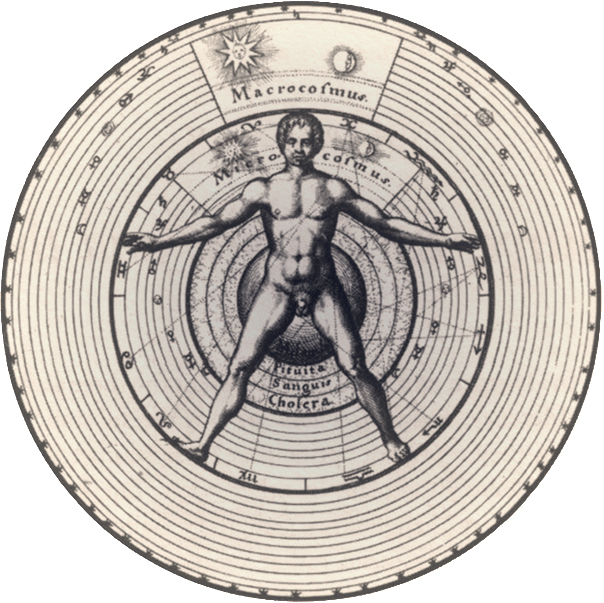
Robert Fludd, Utriusque Cosmi, 1617. Wikimedia Commons. Early modern alchemical plates are maps of correspondence: metals to planets, organs to seasons. Solve et coagula: dissolve a mixture, then bind it again — laboratory Latin, later read as a moral. Read a plate as a table of claimed relations, the way Kepler read solids: a picture that asserts a structure, which you may test or refuse. It is not a product line and not a secret password. Alquimia como diagrama
Robert Fludd, Utriusque Cosmi, 1617. Wikimedia Commons. Las planchas alquimicas son tablas de correspondencia. Solve et coagula: disolver y unir. Palabras de laboratorio. Una estructura que se puede probar o rechazar, no una clave secreta. 
Francisco Goya, Capricho 43, 1799. Wikimedia Commons. An etching is copper bitten by acid, inked, and pressed. Goya’s Capricho 43 shows the artist asleep at a desk while owls and bats rise. The caption is not “reason is evil.” It is: when reason sleeps, monsters breed. Durer 1514 and Goya 1799 are the same craft — line forced into metal — two centuries apart. The web copies the ink. The plate was the memory. Estampa
Francisco Goya, Capricho 43, 1799. Wikimedia Commons. Aguafuerte: cobre, acido, tinta, prensa. El pie no dice “la razon es mala”: cuando duerme, nacen monstruos. Durero 1514 y Goya 1799: el mismo oficio. La web copia la tinta. La plancha era la memoria. EmanationsWorks held in the container: theruna, biosonificacion, terrarios, skatewizards, triunvirato, keanucheese. Instruments: QR generator, NFC Config, SlicePizza. Addresses later. An emanation here is a work that left the container and still points back. Each name is a project, not a metaphor for the slit. The buttons above are their marks. The RSS file lists the same names until the real addresses are set. Nothing on this page is the particle field. That stays on the experiment site. EmanacionesObras: theruna, biosonificacion, terrarios, skatewizards, triunvirato, keanucheese. Instrumentos: QR generator, NFC Config, SlicePizza. QuizUniversal knowledge. Places, science, history, patterns, logic, traditions, feelings. The score counts this page. Culture general knowledge IQ patterns. not a clinical test Logic what follows, and what does not Spirit texts and traditions Feeling names. not a diagnosis QuizConocimiento universal. Lugares, ciencia, historia, patrones, logica, tradiciones, sentimientos. El puntaje cuenta esta pagina. Cultura cultura general IQ patrones. no es una prueba clinica Logica lo que sigue y lo que no Espiritu textos y tradiciones Sentimiento nombres. no es un diagnostico CultureCulturaIQPatterns on this page. Not a clinical test. IQPatrones de esta pagina. No es una prueba clinica. LogicLogicaSpiritTexts and traditions. Not a creed. EspirituTextos y tradiciones. No es un credo. FeelingNames for feelings. Not a diagnosis. SentimientoNombres para sentimientos. No es un diagnostico. Guestbook of observersSign in one bit. White field, black mark. Libro de observadoresFirme en un bit.
|
SLIT EXPERIMENT
LIVE
Local timeCalendar
8 200 000 000
people on Earthpersonas en la tierra |